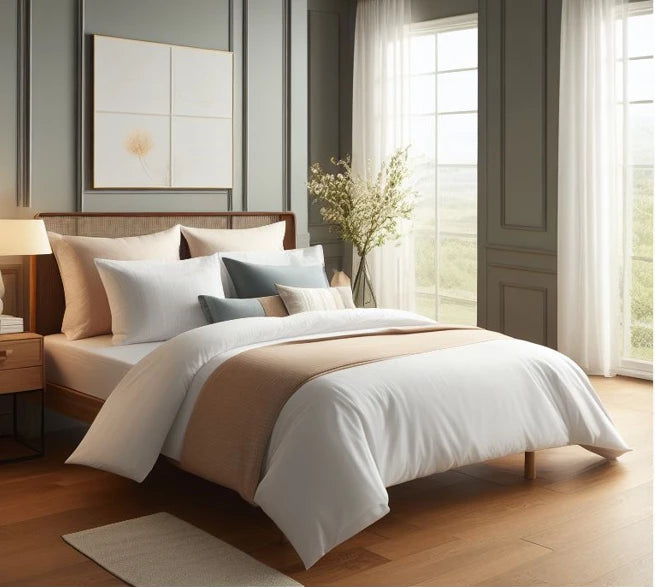


Every Indian who has spent a sleepless night sweating through May has asked some version of this question. You have tried the fan on full speed. You have tried sleeping with wet hair. You have tried everything except looking at what you are actually sleeping on. The material your bed sheet is made from is one of the most direct factors in how cool or hot you feel through an Indian summer night. Some materials genuinely keep you cooler. Others trap heat against your body regardless of how your room is set up. This guide gives you the honest answer without the marketing language most brands use to sell whatever they are already making.
Why Material Matters More in India Than Anywhere Else
India’s summer is genuinely extreme. Delhi crosses 45°C. Chennai combines 38°C heat with coastal humidity. Mumbai adds 85% humidity to already warm nights. Nagpur and Jaipur have dry heat that bakes into walls and radiates back through the night. In these conditions a material that performs adequately in a mild climate becomes actively uncomfortable. The bed sheet material question in India is not a minor preference issue, it is a sleep quality issue that affects how rested you feel every morning from April through September.
The human body cools itself through sweat evaporation. When you sleep, your body temperature naturally rises and falls and sweat is part of how it manages this process. A bed sheet material that absorbs sweat and allows it to evaporate helps your body cool itself. A material that blocks evaporation or reflects heat back at you works directly against your body’s natural cooling process. In Indian summer this difference is felt immediately and every single night.
Materials That Are Not the Coolest Despite What Brands Say
Before getting to the coolest option it is worth being direct about what does not work so Indian buyers stop spending money on materials that are actively making their summers worse.
Microfiber is sold heavily in India as a premium soft option and it is one of the worst materials for Indian summer heat. It is made from extremely fine polyester fibres, synthetic material that does not absorb moisture and reflects body heat back at the sleeper. It feels pleasant in an air-conditioned showroom and becomes uncomfortable within an hour of lying on it in a warm room. In non-AC homes in hot Indian cities, microfiber sheets are genuinely one of the most common and completely avoidable causes of poor summer sleep.
Polyester blends and cotton-rich fabrics have the same problem at varying degrees. The more polyester in the blend, the worse the heat performance. Brands selling 60% cotton 40% polyester sheets as breathable summer options are not being honest about what that polyester content does to airflow and heat retention in real Indian conditions.
Sateen weave, even in 100% cotton, is not the coolest option for Indian summer. The dense smooth surface of sateen reduces airflow compared to other weaves. It is a beautiful fabric for winter or air-conditioned bedrooms but it consistently sleeps warmer than percale cotton in Indian summer heat. If your current sheets feel silky and smooth and you are sleeping hot, sateen weave is likely part of the reason.
High thread count sheets above 400 TC regardless of fabric have a denser weave that reduces the airflow that keeps you cool. Thread count marketing in India is heavily misleading, the 800TC and 1000TC sheets brands push as luxury products are among the worst performing materials for Indian summer heat.
The Coolest Bed Sheet Material for Indian Summer
100% cotton in percale weave is the coolest bed sheet material for Indian summer. This is not a new discovery or a marketing claim from a cotton brand. It is the reason Indian homes have used cotton bedding for centuries and the reason every good hotel in India, from Taj properties to boutique stays, uses cotton percale sheets in their rooms. Cotton works because it is a natural fibre with an open cellular structure that absorbs moisture and allows air to move through the fabric freely.
When you sweat on a cotton percale sheet, the cotton absorbs that moisture away from your skin. The open percale weave then allows air moving across the sheet surface, from a fan or natural breeze, to evaporate that moisture. The evaporation process actively cools the sheet surface. This is the same principle as a clay pot keeping water cool, the material absorbs and releases moisture in a way that produces a cooling effect. No synthetic material replicates this at the price points available to Indian buyers.
Percale weave specifically is the coolest construction for cotton in Indian summer. Percale uses a one-over-one-under weave structure that keeps threads crossing each other rather than floating on the surface. This creates a crisp, matte, flat fabric surface that feels cool to the touch and allows maximum airflow through the weave. The crispness of percale is not just a texture preference — it is a sign of an open weave structure that breathes effectively.
At 180–250 TC, cotton percale has enough thread density to be durable and smooth without the weave becoming dense enough to restrict airflow. This thread count range consistently outperforms higher thread count options in Indian summer conditions because the weave stays open enough for air to circulate and moisture to evaporate.
Long Staple Cotton: The Step Up Worth Knowing About
Within cotton, long staple varieties perform noticeably better than standard cotton for Indian summer. Long staple cotton, Egyptian cotton, Supima cotton, and Indian grown Shankar-6 cotton, has longer individual fibres that create a smoother, stronger weave. The longer fibres mean fewer fibre ends poking out of the weave surface, which means the fabric stays smoother and softer through more washes without pilling or roughening.
For Indian summer specifically, long staple cotton percale maintains its breathability through years of the weekly washing that Indian conditions demand. Standard cotton percale degrades faster under frequent washing in hard Indian water. Long staple cotton holds its structure and breathability significantly longer making it a better value over multiple Indian summers despite the higher initial cost.
Linen: The Alternative Worth Mentioning
Linen is the only other material that genuinely competes with cotton percale for coolest bed sheet material in Indian summer. Linen is made from flax plant fibres and is naturally more breathable than cotton. It absorbs moisture very quickly, dries faster than cotton, and has a natural texture that many people find pleasantly cool against the skin. In humid Indian cities like Mumbai, Kolkata, and Chennai, linen’s fast drying property is a genuine advantage over cotton through monsoon months.
The reasons most Indian buyers choose cotton percale over linen come down to availability, price, and maintenance. Good quality linen sheets are harder to find in India, cost significantly more than equivalent cotton, feel rough and stiff for the first several washes before softening, and require more careful washing to maintain. For buyers willing to invest and patient enough to break linen in over the first few washes, it is an excellent summer material. For most Indian households washing sheets weekly in hard water with a standard washing machine, cotton percale is more practical and delivers comparable cooling performance.
What to Buy and What to Look For
When buying bed sheets specifically for Indian summer coolness, look for these things on the label or product description in this order. First, 100% cotton — not cotton rich, not cotton blend, not premium soft cotton. The label must say 100% cotton. Second, percale weave, the product should mention percale specifically. If weave type is not mentioned and the sheet is described as silky or ultra soft, it is sateen and will sleep warmer. Third, thread count between 180 and 280 TC for non-AC rooms and up to 320 TC for AC bedrooms. Fourth, light colours — white, off-white, light grey, soft pastels, which reflect heat rather than absorbing it.
These four things together give you the coolest bed sheet combination available for Indian summer at any budget. A genuine 200 TC cotton percale sheet in white from a transparent Indian brand will keep you cooler through May and June than any microfiber, sateen, or high thread count synthetic sheet at any price.
For the coolest 100% cotton percale bed sheets made specifically for Indian summer, visit www.belongindia.com, honest about fabric, properly sized for Indian mattresses, and built for the kind of heat India actually has.